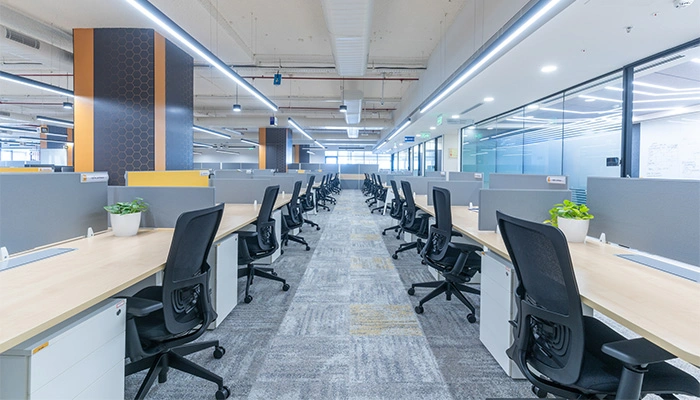
Noida Commercial Real Estate Market Report: Q3 2026 Insights
Updated page copy for propliners.in/noida-office-market-report-2026 | Data period: Q3 2026 (July–September) | Prepared 21 October 2026
PROPLINERS REALTY Market Intelligence Report
Flex operators lead, GCC leasing softens, and Jewar Airport moves from launch to ramp-up
— Published October 2026 | Data period: Q3 2026 (July–September) | Authored by Achal Agarwal, Co-Founder, Propliners Realty 15+ years in Noida commercial real estate | Samsung, KPMG, Microsoft & 200+ FDI clients advised
QUICK GLANCE
Noida’s office market in Q3 2026 comes down to five developments:
- Noida took 27% of Delhi-NCR leasing. NCR recorded 3.8 million sq. ft. of gross leasing in Q3 (9M 2026: 10.7 million). Noida accounted for roughly 1.0 million sq. ft., and the Noida Expressway was the most active sub-market in the region at 20% of NCR volume (Cushman & Wakefield).
- Flex and IT-BPM led; GCCs paused. Flex operators took 32% of NCR leasing. GCC leasing fell to 1.0 million sq. ft., down 31% q-o-q, as large contiguous Grade A+ floor plates ran short.
- Noida vacancy is 19.8%, above the NCR average of 17.6%, with 8.2 million sq. ft. planned or under construction through 2028. Tenants have room to negotiate on ready space.
- Rents are rising, but Noida remains the value market. NCR rents rose 6–9% y-o-y, yet Noida’s Grade A average of ₹62/sq.ft./month sits 35% below the NCR average (₹96) and 59% below Cyber City (₹150).
- Jewar Airport is three months into operations. Commercial flights began on 15 June 2026. Published route lists are domestic, and access is road-based for now.
Nationally, India recorded its highest-ever nine-month leasing volume: 64.6 million sq. ft. across eight cities (Cushman & Wakefield).
Q3 2026: Key Numbers at a Glance
|
Metric |
Q3 2026 |
Source |
|---|---|---|
|
Delhi-NCR gross leasing |
3.8 million sq. ft. (9M: 10.7 million) |
Cushman & Wakefield |
|
Noida share of NCR leasing |
27% (Gurugram 63%, Delhi 10%) |
Cushman & Wakefield |
|
Noida Expressway share of NCR leasing |
20%, the most active sub-market |
Cushman & Wakefield |
|
Noida Grade A vacancy |
19.8% (NCR: 17.6%) |
Cushman & Wakefield |
|
Noida Grade A stock-weighted rent |
₹62/sq.ft./month (NCR: ₹96) |
Cushman & Wakefield |
|
Noida net absorption, Q3 / 2026 YTD |
0.37 / 1.25 million sq. ft. |
Cushman & Wakefield |
|
Noida completions, 2026 YTD |
0.40 million sq. ft. |
Cushman & Wakefield |
|
Noida pipeline, planned and under construction (to 2028) |
8.2 million sq. ft. |
Cushman & Wakefield |
|
Flex share of NCR leasing |
32% |
Cushman & Wakefield |
|
NCR GCC leasing |
1.0 million sq. ft. (−31% q-o-q, −60% y-o-y) |
Cushman & Wakefield |
|
India leasing, 9M 2026 |
64.6 million sq. ft. (record) |
Cushman & Wakefield |
|
GCC share of India leasing, Q3 |
41–42% |
CBRE / Cushman & Wakefield |
Section 01: Market Overview, Q3 2026
India’s office market kept its momentum through the third quarter. Cushman & Wakefield recorded 21.9 million sq. ft. of gross leasing across eight cities (+3% q-o-q) and net absorption of 14.1 million sq. ft. (+26% q-o-q), taking nine-month leasing to 64.6 million sq. ft., the highest ever for that period. CBRE measured Q3 absorption at about 21.0 million sq. ft. (+6% y-o-y). Colliers, tracking seven cities, reported 18.7 million sq. ft. (+9% y-o-y) and expects full-year leasing of 75–80 million sq. ft. Delhi-NCR accounted for about 17% of national leasing in the quarter.
Within NCR the mood was more cautious. Occupiers held back on large commitments, and quarterly leasing slipped 7% q-o-q. Noida contributed 27% of the region’s volume, and the Noida Expressway led every NCR sub-market at 20%, ahead of Gurgaon CBD (18%) and Sohna Road (14%).
Delhi-NCR Q3 2026 leasing: how the research houses compare
|
Source |
NCR Q3 gross leasing |
Note |
|---|---|---|
|
Cushman & Wakefield |
3.8 million sq. ft. |
−31% y-o-y, −7% q-o-q; used for Noida data in this report |
|
Savills India |
3.4 million sq. ft. |
Flex 38%, IT-BPM 17% of NCR leasing |
|
Colliers India |
3.3 million sq. ft. |
+106% y-o-y |
Methodology and base-period treatment differ by firm, so year-on-year swings are not comparable. We cite each figure with its source and use Cushman & Wakefield for sub-market data because it publishes Noida-level Grade A statistics.
Supply and vacancy
NCR net absorption of 2.2 million sq. ft. outpaced new supply of 0.9 million sq. ft., pulling regional vacancy down 101 bps q-o-q to 17.6%. In Noida, net absorption for 2026 stands at 1.25 million sq. ft. against only 0.40 million sq. ft. of completions, so demand has run at roughly three times new supply this year. Noida’s headline vacancy is still 19.8% on a 44.0 million sq. ft. Grade A base, and 8.2 million sq. ft. is planned or under construction through 2028.
Why this matters for tenants The supply wave arrives in 2027–28, not now. For ready-to-move requirements of 10,000–30,000 sq. ft., today’s 19.8% vacancy gives you leverage on rent-free periods, fit-out contributions and escalation. For requirements above 40,000 sq. ft., quality contiguous floor plates are scarce, and pre-commitments in 2027–28 buildings are where your negotiating power sits.
Section 02: Demand Drivers, Who Is Leasing and Why
Flex operators: the quarter’s demand engine
Flex operators took 32% of NCR leasing in Q3, and their volume ran 121% above their quarterly average since 2025 (Cushman & Wakefield). Nationally, flex leased 3.5 million sq. ft. (16% of leasing, Cushman & Wakefield), 4.0 million sq. ft. (+49% y-o-y, Colliers) and 24% of absorption (CBRE). The figures differ because each firm defines flex and its city set differently, but the direction is the same: occupiers are using flex to manage headcount swings.
For tenants this supports a Core + Flex strategy: lease a permanent floor directly and add managed capacity in the same building or corridor for projects and surplus headcount. Price the premium honestly. Accenture’s 1.65 lakh sq. ft. lease at ACE Capitol Tower 2 (Sector 132) was signed with Onward Coworkx, a managed-space provider, at ₹192/sq.ft./month on 164,881 sq. ft. of chargeable area, for five years with 6% annual escalation. That is a managed-office benchmark, not a warm-shell rent.
IT-BPM, BFSI and professional services
IT-BPM took 17% of NCR leasing, but its volume was 49% below its average since 2025 as firms prioritise efficiency over large-scale expansion (Cushman & Wakefield). Nationally, BFSI led Cushman & Wakefield’s sector split at 24%, with IT-BPM at 22%.
Global Capability Centres: strong nationally, constrained in NCR
GCCs accounted for 41–42% of India’s Q3 leasing (about 8.7 million sq. ft. per CBRE; 9.1 million per Cushman & Wakefield), and 82% of CBRE-tracked leasing went to green-certified buildings. In NCR, however, GCC leasing fell to 1.0 million sq. ft. (−31% q-o-q, −60% y-o-y). Cushman & Wakefield attributes part of the drop to limited availability of large contiguous Grade A+ floor plates in prime micro-markets, and points to the 2027–28 pipeline as the window for pre-commitments.
Large-format deals are still closing on the Noida Expressway, and Sector 132 is the cluster to watch:
|
Tenant |
Building |
Size |
Terms |
|---|---|---|---|
|
Sopra Steria |
Maconns Grande, Sector 132 |
4.74 lakh sq. ft. (carpet) |
15 years; ₹79.2/sq.ft./month; 10% escalation every 3 years; 1,125 parking slots; lease commenced 30 May 2026 (reported October 2026) |
|
Accenture |
ACE Capitol Tower 2, Sector 132 |
1.65 lakh sq. ft. (chargeable) |
5 years; ₹192/sq.ft./month; 6% annual escalation; managed space via Onward Coworkx (reported April 2026) |
|
Xavient Software |
The Opus 132 Crown Tower |
70,500 sq. ft. |
Key Q3 2026 lease |
|
MetLife |
Oxygen Business Park, Sector 144 |
75,000 sq. ft. (carpet) |
5 years; about ₹56/sq.ft./month (₹41.8 lakh a month) |
Compare structure, not just headline rent: Sopra Steria is quoted on carpet area with a long lock-in, while Accenture is quoted on chargeable area in a managed building.
UP GCC Policy
The UP Global Capability Centre Policy 2024 (effective 2025) classifies projects as Level 1 (₹20 crore+ investment or 200+ employees in Gautam Buddh Nagar) or Advanced (₹75 crore+ or 500+ employees). Incentives include 100% stamp duty exemption or reimbursement on land or office space, a 25% capital subsidy and payroll support, subject to policy conditions. Confirm eligibility with Invest UP before you structure a lease.
Propliners GCC Advisory Note GCC clients frequently underestimate two costs: the restoration clause (stripping custom fit-out on exit, which can run ₹400–800/sq.ft. on a 40,000 sq.ft. campus) and ODC (Offshore Development Centre) zone compliance for data-sensitive operations. Negotiate both at LOI stage, not at lease execution. Propliners has managed GCC mandates from 500 sq.ft. startup cabins to 40,000 sq.ft. Expressway campuses.
Section 03: Rental Rates and Costs (Q3 2026)
Grade A stock-weighted rents: Noida vs the rest of NCR
|
Market |
Vacancy |
Rent (₹/sq.ft./month) |
Noida’s discount |
|---|---|---|---|
|
Gurugram: Cyber City |
1.3% |
150 |
59% |
|
Gurugram: Golf Course Road |
5.1% |
137 |
55% |
|
Gurugram: MG Road |
5.0% |
131 |
53% |
|
Gurugram: NH-8 Prime |
7.3% |
121 |
49% |
|
Gurugram: Others (Sohna Road, GCE Road, Udyog Vihar and more) |
26.8% |
68 |
9% |
|
Noida |
19.8% |
62 |
n/a |
|
Delhi-NCR average |
17.6% |
96 |
35% |
Source: Cushman & Wakefield Delhi NCR Office MarketBeat Q3 2026. Stock-weighted rents for Grade A space with core facilities, high-side air conditioning and full power backup. Noida excludes Greater Noida.
On these numbers, a 20,000 sq. ft. requirement costs roughly ₹1.4–2.1 crore less per year in Noida than in NH-8 Prime or Cyber City, before CAM, parking and fit-out. Against Gurugram’s outer micro-markets the gap is small, so compare like with like.
Asking-rent ranges by Noida micro-market
|
Micro-market |
Warm shell (₹/sq.ft./month) |
Plug and play (₹/sq.ft./month) |
CAM (₹/sq.ft./month) |
|---|---|---|---|
|
Sector 16B, DND Flyway (premium) |
115–165 |
165–195 |
22–28 |
|
Film City, Sector 16A |
110–155 |
145–180 |
20–26 |
|
Sector 62–63 (established IT hub) |
55–75 |
110–140 |
18–24 |
|
Noida Expressway, Sectors 125–135 |
60–85 |
85–130 |
16–22 |
|
Expressway, Sectors 140–150 (emerging) |
55–85 |
85–115 |
14–20 |
|
Yamuna Expressway / Jewar belt |
45–75 |
70–95 |
12–18 |
Asking rents are what landlords quote; the Cushman & Wakefield averages above are what the stock carries. Negotiated rents depend on specification, floor, lock-in and escalation.
Escalation benchmarks
Registered 2026 deals show a wide spread: 10% every three years on Sopra Steria’s 15-year lease and 6% annually on Accenture’s five-year managed lease. Negotiate the escalation structure at LOI stage, because it compounds over the lock-in period.
Section 04: Micro-Market Deep Dive
Noida Expressway, Sectors 125–144 (the MNC corridor)
The most active sub-market in NCR in Q3 2026, with 20% of regional leasing. Sector 132 has become the deal cluster of the year (Accenture, Sopra Steria, Xavient), alongside established GCC anchors such as Samsung, KPMG, EY, Qualcomm and DMI Finance. Large floor plates of 25,000–100,000 sq. ft. are available in LEED Gold and Platinum buildings, although Cushman & Wakefield notes that contiguous Grade A+ blocks are limited. Aqua Line stations at Sectors 137, 142 and 143 serve the southern belt.
- Rent range: ₹60–₹95/sq.ft. (warm shell); up to ₹130/sq.ft. (managed/plug and play)
- Key buildings: ACE Capitol and Maconns Grande (Sector 132), The Opus 132 Crown Tower, Advant Navis (Sector 142), Max Square (Sector 129), Candor TechSpace SEZ (Sector 135), Stellar 1425 and 1422 (Sector 142), Tapasya Corp Heights (Sector 126), Embassy Oxygen Business Park (Sector 144)
- Notable tenants: Samsung, KPMG, EY, Accenture, Sopra Steria, MetLife, Adobe, General Atomics, TCS, Birlasoft
- Best for: GCCs, delivery centres, LEED-mandate occupiers, Core + Flex strategies
Sector 62–63, established IT hub
Noida’s most mature market, with Blue Line access (Electronic City station), a proven tenant base including HCL, Barclays, Infosys and Amazon, and consistent infrastructure. A fit for large IT and BPO operations that need scalable floor plates and easy commuting from Delhi and Ghaziabad.
- Rent range: ₹55–₹75/sq.ft. (warm shell); ₹110–₹140/sq.ft. (plug and play)
- Key buildings: Candor TechSpace, I-Thum, Stellar IT Park, Logix Cyber Park, Green Boulevard
- Notable tenants: Amazon, Barclays, ICICI Bank, Innodata
- Best for: IT/ITES, BPO, mid-to-large corporate headquarters
Sector 16B and Film City (premium tier)
Sector 16B on the DND corridor is home to Max Towers (LEED Platinum), KP Tower and Berger Tower. Film City (Sector 16A) adds Sovereign Capital Gate, The Ikon Tower and Express Corporate Park, with Microsoft and Hindustan Times as anchors. In our experience, new Grade A land supply on this corridor is effectively exhausted, which keeps premium availability limited. Both pockets sit on the Blue Line, with DND Flyway access to South Delhi. Best for BFSI, consulting and premium MNC headquarters.
- Rent range: ₹110–₹165/sq.ft. (warm shell); ₹145–₹195/sq.ft. (plug and play)
- CAM charges: ₹20–₹28/sq.ft.
Yamuna Expressway / Jewar belt (the long-term play)
The airport is operating, but in our view office demand on the belt is still early. Likely first occupiers are aviation, logistics, hospitality and airport-services businesses, and we expect multinational office demand to lag by 24–36 months while the ecosystem builds. Enter through RERA-registered YEIDA plots or pre-committed projects, and avoid speculative buildings with no confirmed tenant interest.
- Rent range: ₹45–₹75/sq.ft. (warm shell, current)
- Key areas: Sector 22D (Yamuna Expressway), YEIDA plots, Sector 32D/33D
Section 05: The Jewar Airport Effect
Noida International Airport at Jewar (DXN) is live, but it is early in its ramp-up. Phase I was inaugurated on 28 March 2026 and began commercial flights on 15 June 2026 with an IndiGo service from Lucknow. On 9 October 2026 the Uttar Pradesh Cabinet approved renaming it Narendra Modi International Airport, so you will see both names in use.
Airport status at a glance (as of 21 October 2026)
|
Item |
Status |
|---|---|
|
Commercial operations |
Began 15 June 2026 (DGCA aerodrome licence 6 March 2026; inauguration 28 March 2026) |
|
Phase I capacity |
12 million passengers a year; one terminal; one 3,900 m runway |
|
Long-term capacity |
30 million (Phase II, targeted FY31–32 per YEIDA); 70 million at full build-out |
|
Airlines on published route lists |
IndiGo (18 destinations, including Mumbai, Bengaluru, Hyderabad, Amritsar, Jammu and Srinagar) and Akasa Air (Bengaluru, Kolkata, Mumbai, Navi Mumbai) |
|
International flights |
Not on published route lists; guided for late 2026, so confirm current schedules |
|
Surface access |
Road-based via the Yamuna Expressway; metro and rapid-rail links are still at planning stage |
|
Name |
UP Cabinet approved renaming to Narendra Modi International Airport on 9 October 2026 |
What the airport means for office tenants The practical benefit is for companies whose leadership travels often: a second NCR airport reduces dependence on IGI over time. Today, though, access is by road and rail links are still in planning, so we would not yet treat a shorter airport trip from Sectors 125–144 as a reason to choose a location. Treat it as option value that grows as connectivity and international routes arrive.
Airport impact by stakeholder
|
Stakeholder |
Where things stand (Q3 2026) |
12–24 month outlook (Propliners view) |
|---|---|---|
|
Office tenants (MNCs / GCCs) |
Better domestic connectivity; no visible change yet in Expressway leasing patterns |
Value grows as international routes and metro/rail links arrive |
|
Investors in pre-leased assets |
Leasing is concentrated on the Expressway, not the Yamuna belt |
Selective: favour pre-committed, green-certified buildings |
|
Logistics and warehousing |
AISATS selected to develop the cargo hub; NCR warehouse leasing reached about 8 million sq. ft. in H1 2026 |
Cross-dock and e-commerce demand on YEIDA plots |
|
Retail and hospitality |
Airport-linked F&B and transit retail |
Hotels and airport-adjacent retail as early beneficiaries |
Section 06: Outlook and Risk Assessment
The bull case
- A pre-commitment window. Cushman & Wakefield sees the 2027–28 pipeline (8.2 million sq. ft. in Noida) as the opportunity for GCCs that could not find large contiguous space this year.
- Flex and managed demand is structural. Flex leasing in NCR ran 121% above its average since 2025.
- A quality premium. 82% of CBRE-tracked Q3 leasing went to green-certified buildings, which favours LEED and IGBC stock on the Expressway.
- Airport optionality. Connectivity and cargo infrastructure can broaden demand beyond IT over time.
The base case
NCR rents keep rising (6–9% y-o-y in Q3), regional vacancy keeps easing from 17.6% as absorption outpaces completions, and Noida remains the value market at ₹62 against ₹96 for NCR. Noida’s vacancy path depends on how quickly 2027–28 supply is pre-committed.
Key risks to monitor
- GCC concentration: NCR GCC leasing fell 60% y-o-y. If large floor-plate availability does not improve, some GCC demand may route to other cities.
- IT-BPM caution: IT-BPM leasing ran 49% below its average since 2025.
- Supply timing: 8.2 million sq. ft. is in the pipeline against 19.8% current vacancy.
- Macro uncertainty: Cushman & Wakefield flags persistent macroeconomic and geopolitical uncertainty, which can defer lease decisions.
- Speculative Yamuna development: Airport-adjacent projects without confirmed tenant interest carry execution risk.
- CAM disputes: Maintenance-charge disagreements remain the most common tenant-landlord friction point in Noida. Verify and cap CAM at LOI stage.
Section 07: Practical Playbook for Q4 2026
For tenants and occupiers
- Use vacancy as leverage on ready space. At 19.8% vacancy, push for rent-free fit-out periods, fit-out contributions and a lower escalation. In our recent negotiations, landlords in Sectors 125–142 have offered up to 90 days rent-free on warm-shell units.
- Pre-commit early for large requirements. For 40,000+ sq. ft., talk to landlords of 2027–28 buildings now.
- Compare structures, not headline rents. Carpet vs chargeable area and warm shell vs managed space can move the effective rent by a wide margin.
- Negotiate escalation explicitly. Recent registered deals range from 10% every three years to 6% a year.
- Verify CAM components in writing. What is included (HVAC, security, housekeeping, lift maintenance) varies widely between buildings.
- Demand power-load certification. For FinTech, BPO and ITES operations needing 24/7 uptime, confirm transformers and DG sets match your stated load before signing.
- Consider Core + Flex. A direct floor plus managed capacity covers headcount swings without a long lock-in on everything.
For investors and developers
- Underwrite vacancy honestly. Noida’s 19.8% is above the NCR average of 17.6%; pre-leased assets with anchor tenants reduce that exposure.
- Track the 2027–28 pipeline. Buildings with anchor pre-commitments are the strongest value-add opportunities.
- Stage Jewar corridor entry. Infrastructure is live, but full occupier demand will build over years. RERA-registered YEIDA plots suit 5+ year holds.
- Treat ESG as table stakes. Green-certified buildings drew 82% of CBRE-tracked Q3 leasing.
Section 08: About Propliners Realty
Propliners Realty is a zero-brokerage commercial real estate consultancy based in I-Thum, Sector 62, Noida, founded in 2009 and specialising in office space leasing across Delhi-NCR. Our consultancy service is 100% free for tenants: we earn our fee from the landlord side, which means every recommendation we make is aligned with the tenant’s interest.
|
Our Track Record |
|
|---|---|
|
Years in Noida commercial real estate |
15+ |
|
FDI and corporate clients served |
500+ |
|
Verified office listings across Noida |
2,000+ |
|
Brokerage charged to tenants |
₹0, always |
|
Notable clients |
Samsung, KPMG, Microsoft, Renesas Electronics |
Authored by Achal Agarwal
Achal Agarwal is the Co-Founder of Propliners Realty, with over 15 years of hands-on experience in commercial office leasing across Noida, Gurgaon and Delhi NCR. He has personally negotiated office leases for clients including Samsung, KPMG, Microsoft and Renesas Electronics, from 500 sq.ft. startup cabins in Sector 62 to 40,000 sq.ft. GCC campuses on the Noida Expressway. His approach combines deep developer relationships with rigorous technical due diligence, from HVAC specifications and fiber redundancy to lease escalation clause negotiation.
LinkedIn: linkedin.com/in/achal-agarwal-411a4037 | Website: propliners.in
Frequently Asked Questions: Noida Office Market Q3 2026
Q1. What is the current rental rate for Grade A office space in Noida in Q3 2026?
Grade A office space in Noida averaged ₹62/sq.ft./month in Q3 2026 on a stock-weighted basis, against ₹96 for Delhi-NCR (Cushman & Wakefield). Asking rents vary by building and specification: roughly ₹60–₹95/sq.ft. for warm shell on the Noida Expressway and up to ₹130/sq.ft. for managed or plug-and-play space. Recent registered deals include Sopra Steria at ₹79.2/sq.ft. (carpet area, Sector 132) and Accenture at ₹192/sq.ft. (chargeable area, managed space). CAM charges of about ₹12–₹28/sq.ft. are additional.
Q2. What is the office vacancy rate in Noida in 2026?
Noida’s Grade A vacancy was 19.8% in Q3 2026 on a 44.0 million sq. ft. base, against 17.6% for Delhi-NCR (Cushman & Wakefield). Net absorption of 1.25 million sq. ft. so far in 2026 compares with 0.40 million sq. ft. of completions, and 8.2 million sq. ft. is planned or under construction through 2028.
Q3. How has Jewar Airport affected commercial real estate in Noida?
The airport began commercial operations on 15 June 2026 with domestic routes. It has not yet visibly shifted office leasing, which in Q3 stayed concentrated on the Noida Expressway (20% of NCR volume). Over the longer term we expect aviation, logistics and hospitality demand on the Yamuna belt first, with multinational office demand lagging by 24–36 months. Access is road-based today, with metro and rail links still in planning.
Q4. Which areas of Noida have the highest office demand in 2026?
The Noida Expressway was the most active NCR sub-market in Q3 2026, with 20% of regional leasing, and Sector 132 is the standout cluster (Accenture, Sopra Steria, Xavient Software). Sector 62–63 remains the established IT hub, Sector 16 is the premium address, and the Yamuna Expressway / Jewar belt is early-cycle.
Q5. Is Noida still a good destination for a GCC in 2026?
Yes, with a caveat. Noida offers a cost advantage (₹62/sq.ft. average against ₹96 for NCR and ₹150 in Cyber City), LEED Gold and Platinum stock, Aqua Line access and incentives under the UP GCC Policy 2024. The caveat is availability: NCR GCC leasing fell to 1.0 million sq. ft. in Q3 because large contiguous Grade A+ floor plates are limited, so GCCs planning 40,000+ sq. ft. should look at 2027–28 pre-commitments.
Q6. What are CAM charges in Noida and what do they include?
CAM (Common Area Maintenance) charges in Noida range from about ₹12–₹28/sq.ft./month depending on building grade and micro-market. They typically cover security, housekeeping, lift maintenance, HVAC maintenance for common areas, landscaping and common-area electricity. What is included varies significantly between landlords, so request a detailed component breakdown at LOI stage and negotiate a CAM cap clause.
Q7. How does the Noida office market compare with Gurgaon in Q3 2026?
Noida’s Grade A average of ₹62/sq.ft. is 59% below Cyber City (₹150), 55% below Golf Course Road (₹137), 49% below NH-8 Prime (₹121) and 9% below Gurugram’s outer micro-markets (₹68). A 20,000 sq. ft. office costs roughly ₹1.4–2.1 crore less per year in Noida than in NH-8 Prime or Cyber City before CAM and fit-out. Availability differs too: Cyber City vacancy is 1.3% against 19.8% in Noida.
Ready to find your next office in Noida?
Call +91 9899920199 | WhatsApp +91 9899920199 | sales@propliners.in
propliners.in/office-space-for-rent-in-noida
Zero brokerage for tenants. 2,000+ verified listings. Free site visit.
Ready to find your next office in Noida?
Call +91 9899920199 • WhatsApp +91 9899920199 • sales@propliners.in
propliners.in/office-space-for-rent-in-noida
Zero brokerage for tenants. 2,000+ verified listings. Free site visit.

